
Is it worth buying property in Dubai? A clear answer for overseas buyers
Is it worth buying property in Dubai in 2026? For patient buyers, often yes: yields, escrow protection, low UAE tax, real costs and what to check first.
9 min read ·

Published by Plan to Keys. Editorial responsibility: Shaker Abady, founder.
Facts checked against the official sources linked in the text. How we write and check our guides
We are a registered sales partner of DAMAC and Azizi Developments; the developer pays our commission, not you.
The short answer
Yes, buying property in Dubai is often worth it for overseas buyers who want rental income and can hold for five years or more. Gross rental yields average around 6% according to REIDIN's September 2026 index, well above most European cities. The UAE does not tax individuals on rent, and foreigners can own freehold title registered with the Dubai Land Department.
Buyers are also well protected. Off-plan payments go into a project escrow account set by law, every sale is registered with the Dubai Land Department, and RERA, the Land Department's regulatory arm, registers off-plan projects and licenses brokers. The city keeps growing too: Dubai's population passed 4.8 million in September 2026.
This guide sets out the case for buying, where the market stands as of October 2026, and the practical checks that make a good purchase, so you can decide whether Dubai fits your money and your plans.
The numbers behind this question, from population and visitors to transactions, prices and new supply, are charted with their sources in our Dubai property market guide.
In this guide · 8 sections
The short answer, by type of buyer
An income investor holding 7 to 10 years
- Is it worth it?
- Often yes
- Why
- Yields above most European cities, and time on your side through any cycle
A buyer planning to live there part of the year
- Is it worth it?
- Often yes
- Why
- You get use of the home as well as a return
A short-term trader hoping to flip off-plan
- Is it worth it?
- Less suited to 2026
- Why
- Resale buyers are taking their time, so quick flips are harder to plan
Someone using money they may need within 2 years
- Is it worth it?
- Better to wait
- Why
- Property suits money you can leave invested
A buyer who needs a mortgage from a UAE bank
- Is it worth it?
- Possible, with limits
- Why
- Non-resident lending has set rules and off-plan loans are capped
| You are... | Is it worth it? | Why |
|---|---|---|
| An income investor holding 7 to 10 years | Often yes | Yields above most European cities, and time on your side through any cycle |
| A buyer planning to live there part of the year | Often yes | You get use of the home as well as a return |
| A short-term trader hoping to flip off-plan | Less suited to 2026 | Resale buyers are taking their time, so quick flips are harder to plan |
| Someone using money they may need within 2 years | Better to wait | Property suits money you can leave invested |
| A buyer who needs a mortgage from a UAE bank | Possible, with limits | Non-resident lending has set rules and off-plan loans are capped |
Why Dubai property is a good investment for many overseas buyers
Rental yields are higher than most of Europe
REIDIN put Dubai's average gross rental yield at about 6.2% in September 2026, with apartments around 6.6% and villas around 4.4%. Those are gross figures, before service charges, management and empty months. Even after costs, a well-chosen apartment usually nets more than a comparable flat in London, Paris or Munich.
Our guide to Dubai rental yields walks through the step from gross to net in detail, so you know your real figure before you buy.
Ownership is straightforward for foreigners
In Dubai's designated freehold areas, a foreign buyer can own a property outright, with the title registered at the Dubai Land Department. You do not need residency or a local partner. Our explainer on whether foreigners can buy property in Dubai covers which areas qualify and how the title works.
Off-plan money is held in escrow
Under Dubai's escrow law, Law No. 8 of 2007, payments from off-plan buyers go into a project-specific escrow account that is dedicated to building that project. The law also requires the escrow agent to hold back 5% of the account after completion, released a year after units are registered to buyers. It does not fix a handover date, but it means your money is tied to your project, a protection Dubai has had in law since 2007.
Low tax inside the UAE
The UAE does not tax individuals on rental income or capital gains from property they hold personally. Your home country may still tax that income and any gain if you live in the UK or the EU, so plan for it from the start. Our guide to tax on Dubai property for UK and EU residents sets out what to expect.
Demand from a growing city
Dubai's population passed 4.8 million in late September 2026, about 227,000 more than at the start of the year, according to the Dubai Data and Statistics Establishment. Population growth fills rental homes. It is the single most important support for prices and rents over the long run.
Where the market stands in 2026
After several strong years, 2026 has been calmer, and that gives buyers more choice and more room to negotiate.
- Prices have eased from their peak. ValuStrat reported that residential values were about 10% below their February level by August 2026, with apartments about 5% lower than a year earlier and villas about 2% lower. REIDIN's index shows a smaller move, about 1% lower year on year in September.
- Sales have slowed. Cavendish Maxwell reported that home sales by value were 47% lower year on year in the third quarter of 2026, with transactions 38% lower.
- Rents have eased. REIDIN's rent index was about 7% lower year on year in September 2026.
- More homes are arriving. Cushman & Wakefield Core expects around 55,600 homes to be delivered in 2026, the most since 2008, and more than 60,000 in 2027.
Over the longer run, Knight Frank noted that average prices had risen by about 83% over the previous five and a half years. A calmer year means choosing the right unit matters more than it did in the boom, and buyers have time to choose well. Our look at where the Dubai property market sits in its cycle puts this year in context.
What to check before you buy
Each of these is a normal part of buying well in Dubai. For each one, here is what to look at and how it is handled.
Supply in your area
Busy handover years tend to slow rent growth where most new homes land. Not all planned supply arrives at once: Cushman & Wakefield Core noted that about 186,000 of roughly 525,000 homes planned up to 2030 had passed 20% construction progress. Check what else is handing over in the same community around your date, and look for a building with something that sets it apart, such as location, layout or views.
Handover dates
Handover dates in Dubai often move by some months. Your payments stay in the project's escrow account and the home remains yours, while your rent starts later. Check the anticipated completion date and any grace period in the sales and purchase agreement, and plan your budget with some slack. Our guide to buying off-plan in Dubai explains escrow, the Oqood registration and the contract terms.
Selling later
Resale is quickest when the market is rising and takes longer in a quieter one. In 2026, buyers are choosier and take their time. Plan to hold for five years or more, and keep money you might need at short notice somewhere else.
Service charges and running costs
Every building has annual service charges for maintenance, security and shared facilities. Towers with pools, gyms and concierge services cost more to run. Ask for the current figure for a completed building, or the developer's estimate for an off-plan one, and include it in your yield.
Currency
The dirham is pegged to the US dollar, which keeps it stable against the dollar. Your return in euros or pounds moves with the dollar: a weaker dollar trims your rent when you convert it home, a stronger one adds to it. Run your numbers at today's rate and allow a margin either way.
Market mood
Market mood in Dubai can shift quickly. Transactions dipped sharply in March 2026 and then partly recovered, and over the long run the pattern has been recovery. Buy with a plan you can hold through a quieter spell, and you will not need to time it.
Tax at home
No UAE income tax on rent does not end your obligations at home. Take advice in your own country before you commit, so your net figure is the real one.
Running the numbers before you buy
Start with all the costs, not just the price. On top of the purchase price, you pay the Dubai Land Department transfer fee of 4% plus registration and agency costs. On a one-bedroom at AED 1,283,000 (about €317,000), the 4% fee alone is AED 51,320 (about €12,700). Our guide to Dubai property buying costs lists every charge.
Then work out the net yield. As a hypothetical example, an apartment bought for AED 1,000,000 (about €247,000) and let for AED 65,000 a year has a gross yield of 6.5%. Take off a service charge, a letting fee and a month or so empty, and the net figure might be closer to 5%. The calculator below lets you test your own numbers, for a long let or a holiday home.
Calculator
Rental yield calculator
Headline yields are gross. This takes off service charges, management, maintenance and empty weeks, so you see what you would actually keep.
Gross yield
6.5%
AED 96,923 a year
Net yield
4.4%
after costs, before any tax at home
You keep
€16,439
AED 66,577 a year
Service charges are set per building by the Dubai Land Department index (roughly AED 12 to 25 per sq ft a year for most apartments). Holiday homes need a Department of Economy and Tourism permit and pay a Tourism Dirham fee per night. No UAE income tax on rent; you may owe tax at home.
Three ways in, at three budgets
We list launches from DAMAC and Azizi Developments, starting with studios at Azizi Milan from AED 738,000 (about €182,000). Three DAMAC launches show the range of choices an investor has.
- DAMAC District in DAMAC Hills has one and two-bedroom apartments, with one-bedrooms from AED 1,283,000 (about €317,000), a 60/40 plan paid partly at 1% a month during construction, and handover listed for Q3 2029. Its studios have sold out. DAMAC Riverside Views in Dubai Investment Park starts a little higher, at AED 1,367,000 (about €338,000) for a one-bedroom. Either suits a buyer focused on income at the lower end of the market.
- Safa Gate on Sheikh Zayed Road offers mainly one and two-bedroom apartments from AED 2,142,000 (about €529,000), next to Safa Park, with handover in Q4 2029. A central address tends to hold tenant demand well; you pay more for it and the yield is usually lower.
- DAMAC Islands is a townhouse community in Dubailand, with five-bedroom homes from AED 3,930,000 (about €970,000), and handover listed for Q4 2029. Houses have yielded less than apartments in 2026, while villa values have held up better this year.
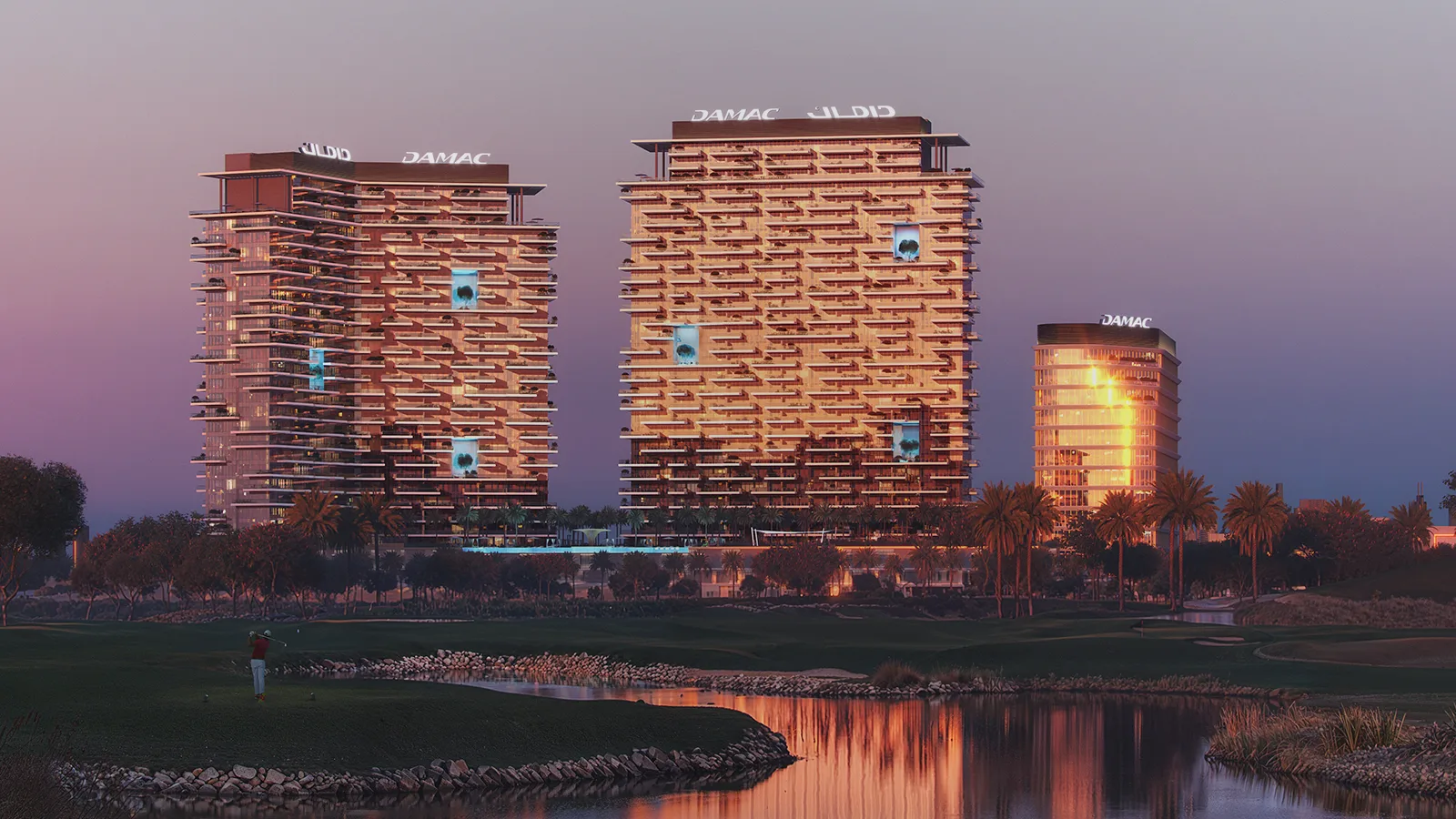
DAMAC Hills
DAMAC District
From AED 1,283,000 ≈ €317k
Q3 2029
1–2 BR · 20/40/40
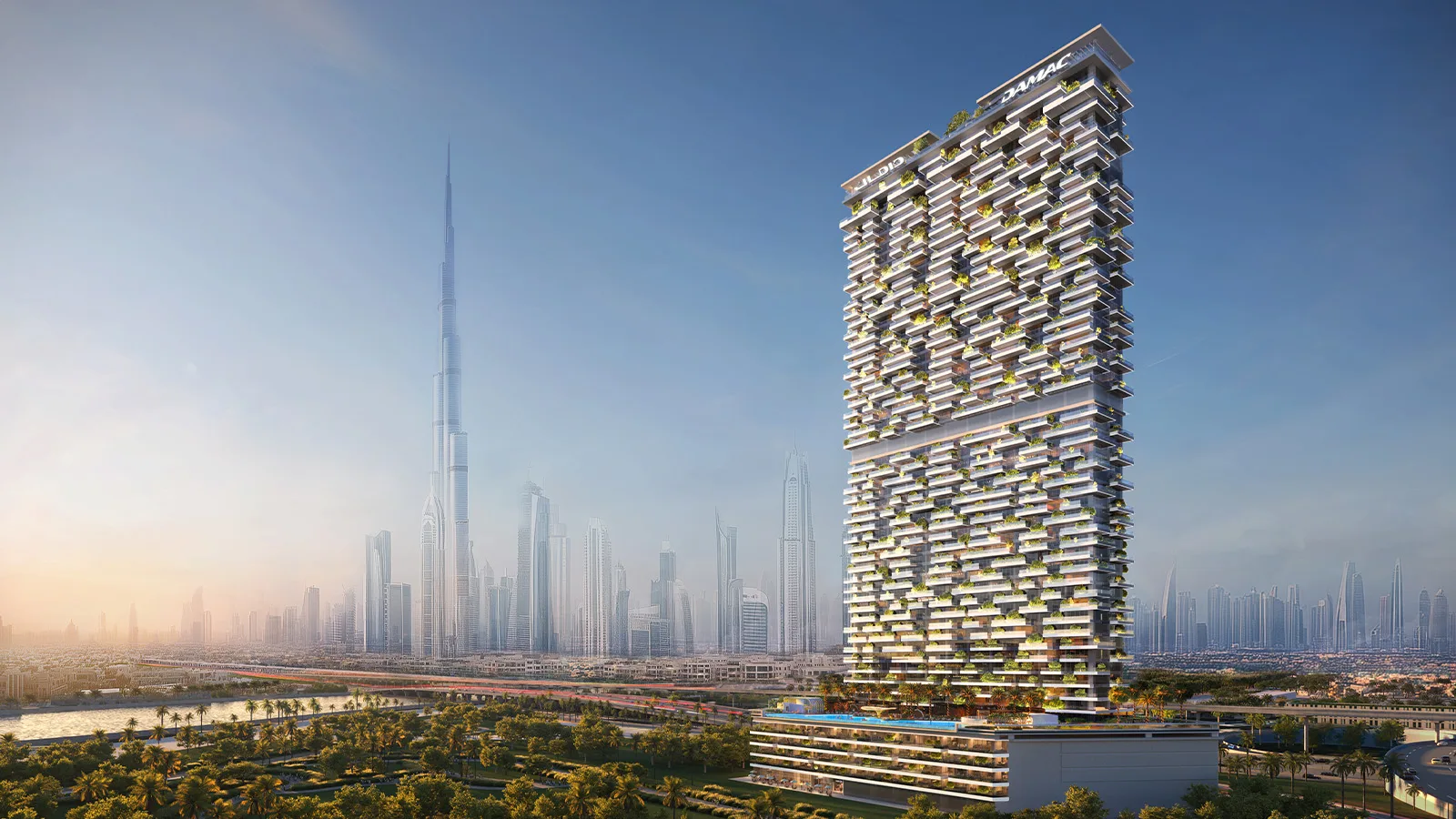
Al Wasl / Sheikh Zayed Road
Safa Gate
From AED 2,142,000 ≈ €529k
Q4 2029
1–2 BR, plus 3 and 5 BR · On request

Dubailand
DAMAC Islands
From AED 3,930,000 ≈ €970k
Q4 2029
5 BR · 75/25
The two higher-priced projects start above the AED 2 million property value used for the property route to the Golden Visa. If residency matters to you, our Golden Visa through property guide explains the conditions.
How to decide
Ask yourself four questions before you sign anything.
- Can I leave this money invested for at least five years?
- Have I worked out the net yield, not just the gross figure?
- Do I know what I will owe in tax at home on the rent and on any gain?
- Could I hold through a 10% to 15% dip in value without needing to sell?
If the answer to all four is yes, Dubai deserves a place on your shortlist. If not, you can take your time and come back when it is. When you are ready, our step-by-step guide to buying from the UK and abroad covers the process, and you can ask for a shortlist and one of our advisers will reply by email or WhatsApp. Plan to Keys is a registered sales partner of DAMAC and Azizi Developments and the developer pays our commission, not you, so weigh our view with that in mind.
Frequently asked questions
Is Dubai property a good investment in 2026?
+
For long-term buyers focused on rental income, it often is. Gross yields average around 6%, according to REIDIN. 2026 is a calmer year, with prices below their February level and rents easing, which gives patient buyers more choice and more room to negotiate.
Is it safe to invest in Dubai real estate?
+
The legal framework is solid: freehold title registered with the Dubai Land Department, projects registered with RERA, and off-plan payments held in project escrow accounts under Law No. 8 of 2007. The checks that remain are commercial ones: handover dates, supply in the area, resale timing and service charges.
Should I buy property in Dubai now or wait?
+
There is no reliable way to time the market. Buyers in 2026 have more room to negotiate than in recent years, and developers are offering incentives such as revised payment plans and fee waivers. If your plan works over seven to ten years, choosing the right building matters more than the timing.
Do I pay tax on Dubai rental income?
+
The UAE does not tax individuals on rental income from property they own personally. If you are resident in the UK or an EU country, you will usually have to declare that income at home. Ask a tax adviser in your country of residence.
How much do I need to buy property in Dubai?
+
On the launches we list, entry-level new one-bedroom apartments start from about AED 1.28 million. DAMAC District, for example, has one-bedrooms from AED 1,283,000 (about €317,000). On top of the price, budget for the 4% Dubai Land Department fee and other purchase costs.
General information as of 24 November 2026, not legal, tax or financial advice. Rules and prices change; ask us to confirm the current position before you commit.
Keep reading
All guidesInvestment · 9 min
Dubai rental yields: what you actually keep after costs
Dubai rental yields average about 6% gross in 2026, above most European capitals. See what you actually keep after costs, and which areas yield the most.
Read the guideInvestment · 10 min
Will the Dubai property market crash? The calm answer for 2026
Will the Dubai property market crash? No: 2026 brought a moderate correction while the population kept growing. What protects buyers now and how to buy calmly.
Read the guideBuying guide · 9 min
Dubai property buying costs: the DLD fee and every charge on top
Dubai Land Department fees explained: the 4% DLD fee, Oqood, trustee and title deed fees, commission, mortgage costs and service charges, with examples.
Read the guideGet a shortlist
Two questions. One honest shortlist.
Tell us what you are after and one of our advisers sends three to five projects that fit, with real payment schedules in euros.