
Can foreigners buy property in Dubai? Freehold rules explained
Can foreigners buy property in Dubai? Yes, as freehold in designated areas. What the law allows, where you can buy, and what ownership does not give you.
8 min read ·

Published by Plan to Keys. Editorial responsibility: Shaker Abady, founder.
Facts checked against the official sources linked in the text. How we write and check our guides
We are a registered sales partner of DAMAC and Azizi Developments; the developer pays our commission, not you.
General information, not tax, legal or financial advice. Plan to Keys sells property: we are not tax advisers, lawyers or financial advisers. Check your own position with a qualified adviser in your country before you buy.
The short answer
Yes, foreigners can buy property in Dubai. Since 2006, Dubai law has allowed people of any nationality to own property outright, on a freehold title registered with the Dubai Land Department (DLD), in areas the government has designated for foreign ownership. You do not need citizenship, a residence visa or a local partner.
The limit is location, not nationality. UAE and other Gulf (GCC) nationals can own anywhere in Dubai. Everyone else, including British, German, French, Dutch and Scandinavian buyers, can own freehold only inside the designated freehold areas. Those areas include most of the places international buyers actually look: the Marina, Downtown, Business Bay, Palm Jumeirah and the large master communities.
This guide explains the law, what freehold means in Dubai, and the limits that overseas buyers should know about as of October 2026.
In this guide · 8 sections
The law that lets foreigners buy property in Dubai
The legal basis is Dubai Law No. 7 of 2006 on real property registration. It keeps general ownership rights for UAE and GCC nationals and allows non-UAE nationals to hold, in designated areas:
- Freehold ownership with no time limit, or
- Usufruct or leasehold rights for up to 99 years.
The areas themselves were first listed in Regulation No. 3 of 2006 and have been extended several times since by later decisions of the Ruler of Dubai. That is why you will see slightly different lists online: the map has grown.
Two points in the law matter for every buyer:
- Buying outside a designated area does not give a foreigner ownership. Any agreement that breaks the law is void, so a contract to buy a villa in a non-designated neighbourhood would not make you the owner.
- Registration creates ownership. A sale only takes legal effect once it is registered with the DLD. A signed contract on its own is a contractual claim, not a title. Off-plan sales are recorded in an interim register (Oqood) under Law No. 13 of 2008 until the building is finished.
The DLD's own frequently asked questions summarise the rule in one line: Emirati and GCC citizens may own in all areas, and foreign ownership is in freehold areas.
Freehold, leasehold and usufruct compared
Freehold
- What you hold
- The unit (and for villas, usually the plot) outright, with a title deed
- How long
- Indefinitely
- Typical use
- Almost all homes sold to foreigners today
Leasehold
- What you hold
- A registered long lease
- How long
- Up to 99 years
- Typical use
- Some older projects
Usufruct
- What you hold
- The right to use and benefit from the property
- How long
- Up to 99 years
- Typical use
- Rare for private buyers
| Type | What you hold | How long | Typical use |
|---|---|---|---|
| Freehold | The unit (and for villas, usually the plot) outright, with a title deed | Indefinitely | Almost all homes sold to foreigners today |
| Leasehold | A registered long lease | Up to 99 years | Some older projects |
| Usufruct | The right to use and benefit from the property | Up to 99 years | Rare for private buyers |
For an overseas buyer, freehold is what you should expect and ask for. It can be sold, let, mortgaged, gifted and inherited. Your name appears on the title deed, which the DLD issues and records.
In an apartment building you own your unit outright and share the common areas with the other owners through an owners' association. That association sets the annual service charge, which you pay whether or not you live there.
Where foreigners can buy: freehold areas in Dubai
Freehold areas cover most of the neighbourhoods built for the international market since the early 2000s. Commonly cited examples include Dubai Marina, Jumeirah Beach Residence, Downtown Dubai, Business Bay, Palm Jumeirah, Emirates Hills and Dubai Sports City, alongside large master communities developed for mixed ownership.
Every project currently listed on this site is in a freehold area, from city towers to suburban communities:
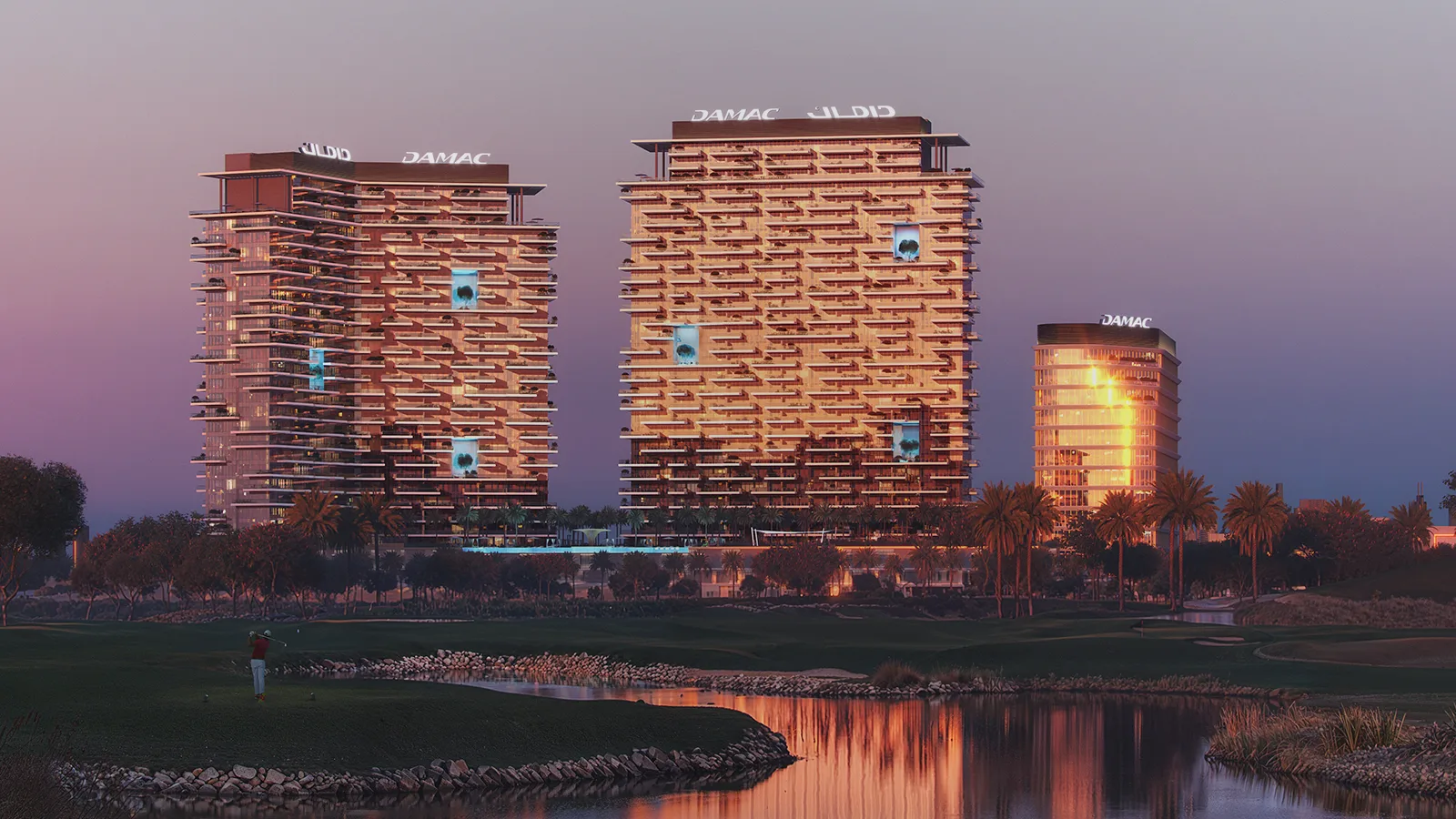
- DAMAC District in DAMAC Hills, one and two-bedroom apartments and offices, with one-bedrooms from AED 1,283,000 (about €317,000), on a 60/40 plan paid partly at 1% a month and handover due in Q3 2029.
- DAMAC Riverside Views in Dubai Investment Park, one and two-bedroom apartments from AED 1,367,000 (about €338,000), with handover due in Q1 2029.
- Branded towers in Business Bay on the Dubai Canal, with studios from about AED 1.4 million and larger units at much higher price points.
DAMAC Hills
DAMAC District
From AED 1,283,000 ≈ €317k
Q3 2029
1–2 BR · 20/40/40

Dubai Investment Park
DAMAC Riverside Views
From AED 1,367,000 ≈ €338k
Q1 2029
1–2 BR · On request
Before you commit to any address, ask the broker to confirm it is in a designated freehold area and that the developer can register the sale in your name. Our guide to the best areas to invest in Dubai compares the main options by budget.
Who can own: individuals, couples and companies
Individuals. Any adult foreigner can buy in their own name with a passport. You do not need to be resident in the UAE.
Joint owners. Couples, family members or friends can buy together. The title deed records each owner's share, so agree the split at the start, because it matters for resale, inheritance and tax at home.
Companies. Some buyers hold property through a company. The DLD accepts certain company types, but the rules and documents differ by structure and the costs rise. Take legal advice before going down this route.
Minors. A child can be registered as an owner, with a guardian signing on their behalf.
What owning property in Dubai gives you
Ownership gives you the full range of property rights: you can live in the home, let it long-term, sell it, mortgage it or leave it to your heirs. For many overseas buyers the bigger draw is what comes alongside it.
- No UAE tax on rent for individuals. Rent earned by an individual holding property personally, as a passive investment, falls outside UAE corporate tax. Your home country may still tax it, which our guide to tax on Dubai property for UK and EU residents explains.
- A route to residency. Property worth at least AED 2 million (about €494,000) can qualify you for a UAE Golden Visa, according to the UAE government portal u.ae. The conditions and the visa length depend on how the property is held, so check yours.
Calculator
Golden Visa eligibility check
The 10-year UAE Golden Visa through property needs your share of one or more Dubai properties to be worth at least AED 2 million (about €494,000).
This reaches the Golden Visa threshold
Value counted: AED 2,142,000 (≈ €528,889). Off-plan counts when the developer is on the Dubai Land Department's approved list.
A first check, not an approval. The authorities decide each application. Off-plan purchases must be from a developer approved by the Dubai Land Department, mortgaged properties need a no-objection letter from the bank, and the rules change; ask us to confirm the current requirements before you apply.
Our full guide to the Dubai Golden Visa through property covers the documents, cost and process.
What owning property does not give you
Owning a Dubai home is a property right, not a status. It helps to be clear on its scope.
- No citizenship. UAE citizenship is not granted through property purchase.
- No automatic visa. Residency is a separate application with its own conditions. Besides the Golden Visa, Dubai offers a two-year property owner residence visa; Khaleej Times reported in 2026 that its minimum property value had been relaxed for sole owners, without a formal announcement, so check the current criteria before relying on it.
- No change to your tax residency. If you keep living in the UK, Germany or France, you stay tax resident there.
- No exemption from local rules. Short-term holiday letting needs a permit from Dubai's Department of Economy and Tourism. Our guide to Airbnb rules in Dubai covers it.
- No automatic inheritance under your home rules. The simple answer is a will recognised in the UAE, and many non-Muslim owners register one, for example through the DIFC Courts Wills Service. Without it, passing on your property can be slower and may not follow your wishes.
What to check as a foreign buyer
The freehold system is mature and well regulated, and the points that matter for owners abroad each have a practical answer.
- Distance. From abroad, a reliable property manager handles the letting, repairs and day-to-day questions for you.
- Currency. The dirham is pegged to the US dollar, so your return in euros or pounds moves with the exchange rate. Keep a buffer in your budget.
- Off-plan timing. Many foreign purchases are off-plan. Escrow law protects your payments, and handover dates can move, so check the completion terms in the contract. Our guide to buying off-plan in Dubai explains how.
- Costs on top. The DLD charges a 4% registration fee on every purchase, plus smaller fees. See Dubai property buying costs before you set a budget.
If you want to see what your budget buys in a freehold area, our step-by-step guide to buying from the UK and abroad is the next read, or ask for a shortlist through the enquiry form. Plan to Keys is a registered sales partner of DAMAC and Azizi Developments, and the developer pays our commission, not you.
Frequently asked questions
Can you buy a house in Dubai without citizenship?
+
Yes. Foreigners do not need UAE citizenship, a residence visa or a local sponsor to buy. Any nationality can own freehold property in Dubai's designated freehold areas with a passport.
Can foreigners own land in Dubai?
+
In designated freehold areas, yes. A freehold villa or townhouse normally includes the plot it stands on, and freehold plots are also sold in some communities. Outside those areas, foreigners can hold leases but not freehold ownership.
Does buying property in Dubai give you residency?
+
Not automatically, but it can make you eligible to apply. Property worth AED 2 million or more can qualify you for a Golden Visa, subject to conditions, and smaller purchases may qualify for a two-year property owner visa. Each is a separate application with medical checks and fees, and the criteria change, so confirm them before you buy.
Can foreigners get a mortgage in Dubai?
+
Yes, from UAE banks that lend to non-residents, usually at lower loan-to-value than residents receive. For off-plan property the Central Bank caps lending at 50% of the value. Our non-resident mortgage guide has the detail.
What happens to Dubai property if a foreign owner dies?
+
The property passes to heirs, but without a will recognised in the UAE the process can be slow and the outcome may not match your wishes. Many foreign owners register a will in Dubai, for example with the DIFC Courts Wills Service, and take advice on how it fits with their will at home.
General information as of 24 November 2026, not legal, tax or financial advice. Rules and prices change; ask us to confirm the current position before you commit.
Keep reading
All guidesBuying guide · 10 min
How to buy property in Dubai from the UK and abroad, step by step
How to buy property in Dubai from the UK or abroad: freehold rules, documents, the 4% DLD fee, buying remotely by power of attorney and getting the title deed.
Read the guideResidency & tax · 9 min
Dubai Golden Visa through property: requirements, cost and process
How the Golden Visa in Dubai works through property in 2026: the AED 2 million rule, off-plan and mortgage conditions, fees, family cover and timing.
Read the guideBuying guide · 9 min
Dubai property buying costs: the DLD fee and every charge on top
Dubai Land Department fees explained: the 4% DLD fee, Oqood, trustee and title deed fees, commission, mortgage costs and service charges, with examples.
Read the guideGet a shortlist
Two questions. One honest shortlist.
Tell us what you are after and one of our advisers sends three to five projects that fit, with real payment schedules in euros.