
Will the Dubai property market crash? Reading the cycle calmly
Will the Dubai property market crash? Prices have dipped in 2026. What the data shows, how 2008 and 2014 compare, and what the forecasts say, without hype.
10 min read · Updated 13 October 2026 · Independent guide, checked against official sources
The Dubai property market has not crashed, but it is going through a correction. ValuStrat measured residential values about 10% below their February 2026 level by August, after buyer confidence weakened in the spring. Since then monthly moves have been close to flat. Most forecasters, including S&P Global Ratings, expect any further decline to be gradual rather than sudden.
A fall on the scale of 2008 to 2009, when prices roughly halved, would need a much bigger shock than the market faces today. That does not make Dubai safe from further falls. Record handovers, easing rents and weaker sentiment could all push prices lower over the next year or two. The sensible response is neither panic nor bravado, but a plan that works even if prices drift down.
This guide sets out where the market stands as of October 2026, what happened in the last two downturns, what has changed since, and what the forecasts say.
Where the Dubai property market stands now
The boom of 2021 to 2025 was strong. Knight Frank estimated that average residential prices rose by about 83% over five and a half years of uninterrupted growth. In 2026 the picture changed.
- Prices: ValuStrat's index fell about 4% in the first quarter and another 4% in the second, its first declines since the pandemic. Monthly falls eased from about 6% in March to about 1% in May and June, and to 0.2% in August. REIDIN's index rose slightly in September and was about 1% lower than a year earlier.
- Sales: Cavendish Maxwell reported that home sales by value fell 47% year on year in the third quarter of 2026, with the number of transactions down 38%.
- Rents: REIDIN's rent index was about 7% lower year on year in September 2026.
- Supply: Cushman & Wakefield Core expects about 55,600 homes to be delivered in 2026, the most since 2008, and more than 60,000 in 2027.
- Population: Dubai's population still grew, by about 227,000 in the first nine months of 2026 to more than 4.8 million, according to the Dubai Data and Statistics Establishment.
Put together, this is a market that has taken a real hit to activity and a moderate hit to prices, while the population underneath it keeps growing. Our guide to Dubai property prices gives the current averages in euros and pounds.
What happened in 2008 to 2009
The last true crash began in late 2008. Reuters polling of analysts at the time put the fall at more than half from the 2008 peak.
Several things came together. Buyers were flipping off-plan contracts several times before a building was even started. Lending was loose. The global financial crisis cut off credit almost overnight, and some of the largest developers ran into debt problems. Many projects were cancelled or stalled for years, and some buyers lost deposits.
That episode shaped much of the regulation Dubai has today.
What happened in 2014 to 2019
The second downturn looked very different. After peaking in mid-2014, prices slid slowly for about five years. ValuStrat reported that citywide values in 2019 were around 30% below their 2014 peak.
There was no single shock. Lower oil prices, a strong US dollar (which made the dirham-priced homes more expensive for many foreign buyers) and a steady flow of new supply wore the market down gradually. It was a grind, not a crash, and it ended only when demand picked up strongly from 2021.
For investors, the lesson of 2014 to 2019 is arguably more relevant than 2008. Oversupply tends to produce long, flat-to-falling periods rather than sudden collapses.
What is different this time
Off-plan money is ring-fenced
Under Law No. 8 of 2007, developers selling off-plan must open an escrow account for each project, and buyers' payments go into that account, which is dedicated to building the project. The escrow agent must hold back 5% after completion for a year after units are registered to buyers. If a project is not completed, the law requires the escrow agent, working with the authorities, to protect depositors, either by securing completion or by returning payments. This does not make off-plan risk-free, but it is a very different position from 2008. Our guide to buying off-plan in Dubai explains how it works in practice.
Lending is capped
The UAE Central Bank introduced loan-to-value limits on mortgages in 2013. Banks can lend no more than 50% of the value of an off-plan home, whoever the buyer is, and limits for completed homes depend on residency, value and whether it is a first home. Less borrowing means fewer forced sellers when prices fall. Our guide to a mortgage in Dubai as a non-resident has the detail.
The population is larger and still growing
Dubai crossed 4 million residents in 2025 and passed 4.8 million in September 2026. Even through the spring disruption, it kept growing. In 2008 and 2014, demand was thinner and more dependent on short-term speculation.
What is the same, or riskier
A large supply wave
The handovers forecast for 2026 and 2027 are the highest since 2008. Some will slip: Cushman & Wakefield Core noted that only about 186,000 of roughly 525,000 homes planned up to 2030 had passed 20% construction progress. Delays spread supply out, which helps, but the areas with the most completions are still likely to see pressure on rents and resale prices.
Off-plan dominates sales
ValuStrat reported that off-plan registrations made up 73% of residential sales in August 2026. Many of those buyers are investors who will want tenants or buyers at handover. If many of them try to sell at once, resale prices in those buildings can soften.
Rents are falling
Falling rents reduce what new investors are willing to pay. If the rent decline REIDIN measured continues, it will weigh on prices with a lag.
Sentiment can turn quickly
The spring of 2026 showed how quickly sentiment can turn. Reuters reported in March 2026 that some sellers were cutting asking prices by 12% to 15% within weeks. Another drop in confidence would weigh on prices again.
Dubai property market forecast: what the analysts say
| Forecaster | View | When |
|---|---|---|
| Fitch Ratings | Correction of up to 15% across late 2025 and 2026, driven by supply; later reported to expect a larger fall | May 2025, updated mid-2026 |
| Citi | Bearish case of average price falls of about 7% a year from 2026 to 2028 | March 2026 |
| S&P Global Ratings | Prices fell 5% to 15% from end-2025 to September 2026; any further correction expected to be gradual, with apartments softer than villas | October 2026 |
| Knight Frank | Mainstream prices eased 5% to 20% depending on location; prime areas more resilient | Mid-2026 |
| ValuStrat | Monthly declines easing, pointing towards gradual stabilisation | July 2026 |
No forecaster is predicting a 2008-style collapse. The range of views runs from stabilisation to several more years of modest falls. Nobody, including us, can tell you which is right.
Dubai property prices are not falling evenly
The 2026 correction has been uneven.
- Apartments have fallen more than villas. ValuStrat measured apartments about 5% lower year on year in August and villas about 2% lower.
- Prime areas have held up better. Knight Frank described a two-speed market, with prime communities more resilient than the mainstream.
- Offices have kept rising. ValuStrat's office index was about 14% higher year on year in the second quarter, on a shortage of good space.
Averages hide a lot. A building completing next to thousands of similar flats is in a different position from an established address with little new supply nearby.
How a calm buyer approaches this market
Stress-test the numbers
Before you buy, ask what happens if prices fall another 15% and rents fall another 10%. If the answer is "I would have to sell", the purchase is too tight. If the answer is "I would keep collecting rent and wait", you are in a sound position.
Hold for long enough
Both previous downturns were followed by recoveries, but the 2014 cycle took the better part of a decade to play out. Buy with a horizon of seven to ten years, not two.
Keep leverage low
Forced sellers drive prices down in a falling market. Buyers with little or no debt can wait.
Negotiate
A softer market is a buyer's market. Developers have been offering revised payment plans, fee waivers and bulk discounts, according to Khaleej Times reporting on Cushman & Wakefield Core's research. On resales, sellers who need to move have more reason to agree a lower price.
Think about timing of handover
An off-plan home completes years after you buy. Two of the launches we list show this:
- Safa Gate on Sheikh Zayed Road, from AED 2,135,000 (about €527,000), is due for handover in Q4 2029. Central addresses with little new supply nearby tend to hold tenant demand better in a soft market, though nothing guarantees that.
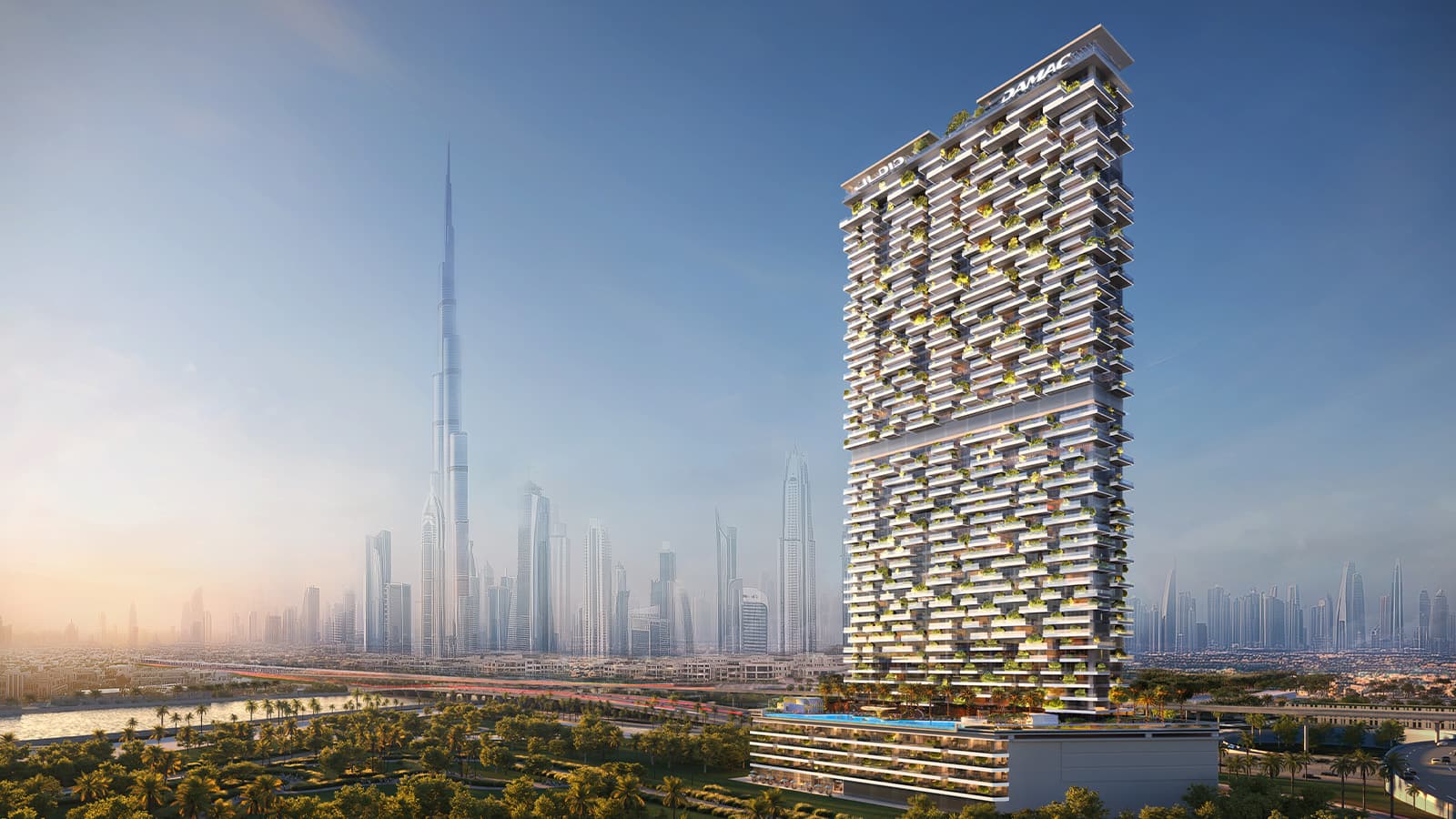
- DAMAC Riverside Views in DAMAC Riverside, from AED 795,000 (about €196,000) with instalments from AED 1,800 a month during construction, is due in Q1 2029. A low ticket and small monthly payments limit how much you have at stake before completion.
Al Wasl / Sheikh Zayed Road
Safa Gate
From AED 2,135,000 ≈ €527k
Q4 2029
1–2 BR · Payment plan available (ask for the current release)

Dubai Investment Park
DAMAC Riverside Views
From AED 795,000 ≈ €196k
Q1 2029
1–2 BR · From AED 1,800 a month during construction
Both are due to complete after the peak delivery years currently forecast for 2026 and 2027. That is no promise of a better market in 2029, but it does mean you are not competing with the current handover wave for tenants.
What to watch over the next twelve months
- Monthly price indices from ValuStrat and REIDIN. Flat readings would confirm stabilisation; renewed falls would not.
- Dubai Land Department transaction numbers, especially resales, which show what end buyers will pay.
- Rents. Falling rents are the clearest sign of oversupply.
- Handovers against forecasts. Big delivery months in a single area are when local prices are most vulnerable.
- Population. Continued growth is the best support the market has.
- Buyer confidence. Steady confidence supports prices more than any other single factor.
If you want to judge whether Dubai still fits your plans, our guide to whether it is worth buying property in Dubai weighs the case for and against, and our guide to Dubai rental yields shows what income to expect. When you are ready, you can ask for a shortlist from a RERA-licensed partner broker.
Frequently asked questions
Is the Dubai property market going to crash?+
Most analysts expect a gradual correction rather than a crash. Prices fell about 10% from February to August 2026 on ValuStrat's index, and monthly falls have since slowed to almost nothing. A 2008-style halving would need a far bigger shock than the market currently faces, but further modest falls are possible.
Are Dubai property prices falling in 2026?+
Yes, in the spring. ValuStrat measured a drop of about 10% between late February and August 2026, with apartments falling more than villas. By August and September, monthly moves were close to flat on both ValuStrat's and REIDIN's indices.
How much did Dubai property prices fall in 2008?+
Reuters polling of analysts at the time put the fall at more than half from the 2008 peak. The crash was driven by speculative off-plan flipping, easy credit and the global financial crisis.
What is the Dubai property market forecast for 2027?+
Forecasts range from stabilisation to modest annual falls. S&P expects a gradual correction with apartments softer than villas, while Citi's bearish case, published in March 2026, was for falls of about 7% a year to 2028. Supply of more than 60,000 homes due in 2027 is the main reason for caution.
Is my off-plan payment safe if the market falls?+
A falling market does not by itself affect your contract. Your payments go into a project escrow account under Law No. 8 of 2007, which is dedicated to building that project. The bigger risks are delays and the resale value at handover, so buy only what you can hold through completion.
Is now a good time to buy property in Dubai?+
Nobody can time the bottom. Buyers have more negotiating power in 2026 than they did during the boom years. If the numbers work at today's rent, you can hold for seven years or more and you are not relying on debt, a soft market can be a reasonable time to buy.
General information as of 13 October 2026, not legal, tax or financial advice. Rules and prices change; a licensed broker confirms the current position before you commit.
Keep reading
All guidesInvestment · 9 min
Dubai property prices in 2026, in euros and pounds
Dubai property prices in October 2026: average values per square foot and square metre in euros and pounds, how far prices have dipped, and what new homes cost.
Read the guideInvestment · 9 min
Is it worth buying property in Dubai? An honest answer for Europeans
Is it worth buying property in Dubai in 2026? A straight answer on prices after the spring dip, real yields, costs, tax at home and who should wait.
Read the guideBuying guide · 9 min
Buying off-plan in Dubai: escrow, Oqood and how your money is protected
Buying off-plan in Dubai explained: how escrow and Oqood registration protect your money, the steps to buy, the 4% DLD fee and the risks the law leaves to you.
Read the guideGet a shortlist
Five questions. One honest shortlist.
Tell us what you are after and a licensed partner sends three to five projects that fit, with real payment schedules in euros.
Step 1 of 5